Design case
From Compliance to Connection
Designing a more responsive entry point into assignments with generative AI
What this is
The workspace is a free web page that asks a student four short questions about what they bring to an assignment, then rewrites the assignment prompt around those answers.
The objectives and the rubric stay exactly as the instructor wrote them, so the memo a student hands in is the same memo every other student hands in, and what moves is only the way into it. A language model does the rewriting, working from nothing but the four answers the student typed, and it is never called again once the writing starts. There is no login, no account and no database anywhere behind it.
I built it for the student who reads an assignment, understands every word of it, and still cannot find a place to start. Time spent circling a prompt is time not spent on the thinking the assignment was set for, and in my experience that stall has little to do with what a student is capable of. Self-determination theory, which holds that people work more carefully on something they have a stake in, gave me the language for what I wanted the opening move to do. The other reader I had in mind is the instructor who wants to offer a way in without lowering what the assignment asks for.
The assignment
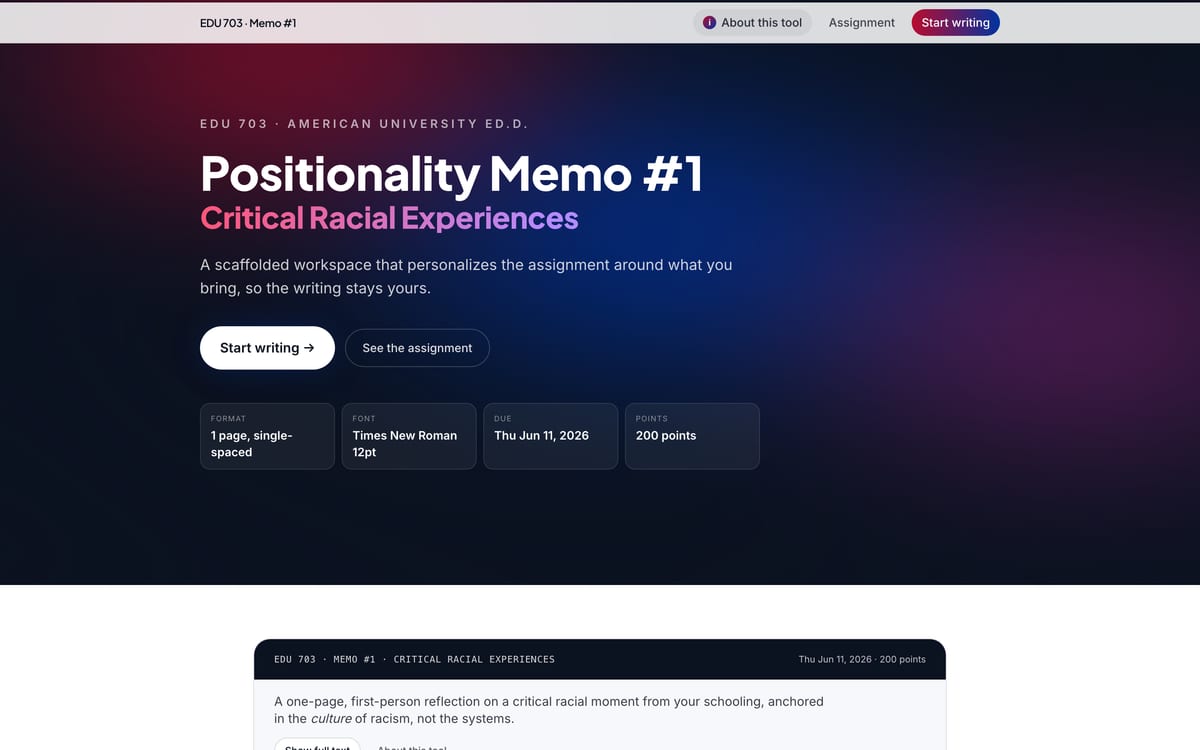
I built the design on Positionality Memo 1, Critical Racial Experiences, in EDU 703, a foundational course in my own doctoral program at American University. The one-page, first-person memo is worth 200 points, and it asks students to describe critical racial moments from their own schooling and account for how those moments shape the way they later read data. The prompt asks for the culture of racism a student lived inside rather than the systems around it. Three objectives sit under it, which are reflexive awareness, culture-of-racism analysis, and lens-to-inquiry. Though the assignment is difficult on purpose, the difficulty I set out to address was the distance between a student and the first sentence.
Where the design came from
Ryan and Deci (2000, 2017) identify autonomy, competence, and relatedness as basic psychological needs. They also name a felt lack of competence, along with a lack of interest or value, as sources of amotivation. That framing pointed my attention at the entry point rather than the work itself, since a student who cannot find a way in has no way to show me what they can do. Autonomy here comes from starting with the student's own inquiry, and competence comes from keeping the objectives visible while the student writes, but I do not claim that a generated prompt can create belonging. Relatedness is the need my design leaves alone.
What stayed fixed
The decision that shaped everything else was my decision about what the model may not touch. The objectives stay fixed, the rubric stays fixed, the memo a student turns in is the same memo every other student turns in, and what moves is only the route in. The workspace asks four short questions about the settings that shaped the student's racial experience, one critical moment from their schooling, their current inquiry, and the lens it built. From those four answers the model writes questions that use the student's own details to push them to explain, connect, and examine the thinking they arrived with. I instructed it to invent nothing, to name only what the student supplied, and to never infer identity. A model asked to personalize past what it was given will start filling the gap with what it assumes about the student.
The workspace
I built the workspace as a Next.js application and deployed it at edu703memo.vercel.app, where it runs with no login, no database, and no analytics. Students type about their own racial experiences, so my architecture stores nothing, although their answers do pass through a commercial model provider once during generation, which I disclosed before use. The last step hands the student a Word document carrying the personalized prompt, their own intake, the unchanged rubric, and a place to write. The model is not called again, so it designs the entry point and the student does the writing.
The finding
In June 2026, nine of the 33 students who submitted the reworked assignment used the reworded prompt the workspace produced.
That number reports uptake and not quality. This was a design deployment and not a measured study, so what it establishes is that the workflow can be built and used on a graded assignment. I did not measure learning, and I have no measure of memo quality or student experience.
What the case shows and does not show
I chose not to collect student-level data, which protects students from having a database of personal racial experiences built for this project, but it also removes any record of what happened after launch. I cannot tell how many students opened the site, abandoned it, received a question that did not fit, or generated a document they chose not to turn in. The other 24 submissions tell me nothing about why those students did not use it. However, this first assignment was a favorable test, since positionality is personal by definition. The harder case is a broad assignment where a student has several directions available and cannot settle on one. So this case leaves open the question I would most want answered: does a student who enters an assignment through a generated prompt learn how to enter the next one alone?
My position in the work
My involvement runs through every stage: I designed the framework, wrote the generation instructions, built and deployed the application, and took the course. I also used the tool for my own graded memo, which means one of the nine submissions was mine. Dr. William Thomas IV, who teaches the course, gave me the aggregate count and no names. No independent evaluator reviewed my design or its output, so this is my account and not an evaluation.
The next test
In the next version I could ask students to write some of those questions themselves, compare them against the model's, or reach for the scaffold only when they are stuck. What I want students to recognize are the moves involved in getting started, which are narrowing a task, connecting it to what they know, examining assumptions, and deciding what they want to say. I would rather the scaffold fade than become the thing they cannot write without.
On the screen
The three objectives, unchanged
- Reflexive awareness
- Culture-of-racism analysis
- Lens-to-inquiry
The four questions the workspace asks
- Which educational settings shaped your racial experience, and what was your role in each?
- Which critical racial moment from your schooling do you keep returning to, and why?
- What is your current research inquiry or environmental scan focus?
- How does that racial memory shape the lens you bring to data, what are you quick to trust, or distrust?
The workspace, running
Public, free, no account. A full cycle, landing to download, takes five to ten minutes; the AI designs the prompt and is never called during the writing.
Read the whole thing
The design case carries the generation rules, one full generated cycle from a fictional intake, and the interface as a student meets it.
Cited on this page
- Ryan, R. M., & Deci, E. L. (2000). Intrinsic and extrinsic motivations: Classic definitions and new directions. Contemporary Educational Psychology, 25(1), 54 to 67.
- Ryan, R. M., & Deci, E. L. (2017). Self-determination theory: Basic psychological needs in motivation, development, and wellness. Guilford Press.