An open question
Montgomery College's Academic Master Plan asked for AI-inclusive curriculum guidelines, and a goal set at that altitude does not tell you what to build. When I picked this work up, the question in front of the college was open. What do you say about generative AI in coursework when faculty disagree about it, and when that disagreement is pedagogically sound? A student can sit in two classrooms on the same day, one that bans AI outright and one that requires it, and then read a job posting that evening listing AI fluency as a requirement. Faculty disagreement was never the thing I wanted to fix, since a composition instructor and a nursing instructor have good reasons to draw the line in different places. My problem was that students could not read those differences, because every classroom described its expectations in language it had written for itself.
A vocabulary rather than a rule
A policy was the obvious shape for the work, but a policy is not what the team built. A single rule applied evenly across every discipline either bans AI in work where it genuinely belongs or permits it in work where the drafting is the point, and both failures land on faculty judgment instead of supporting it. I led a cross-functional faculty and staff team drawn from across the college. What we decided was to build a shared vocabulary rather than a rule, and to set that vocabulary at the level of the assignment.
Assignment level is the decision that carries the most weight, and it is the one I would defend first. A course-level policy cannot describe a course whose first essay allows no AI at any stage but whose final project asks students to design an AI workflow. Most courses in my experience turn out to have that shape once a faculty member looks at them assignment by assignment. Moving the scale down to the assignment moved the authority down with it, and faculty pick the level that fits the learning goal rather than the level the college hands them.
Adapted, not invented
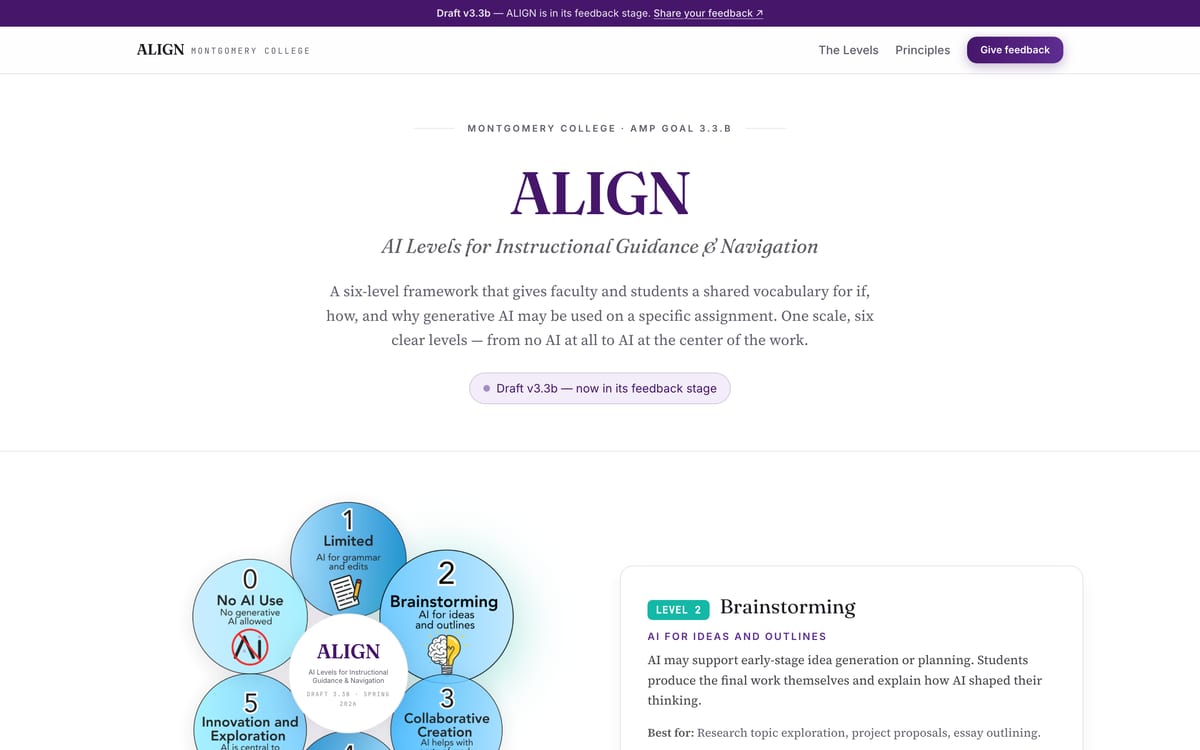
We also decided not to invent a scale. ALIGN adapts the AI Assessment Scale (Perkins, Furze, Roe, and MacVaugh, 2024) to Montgomery College's context, so the team's work was translation rather than taxonomy. Though the six levels are recognizable to anyone who knows that literature, the work that mattered was making them usable inside this particular college.

What each level carries
Each level ships with three things attached rather than a definition standing on its own. A faculty member gets sample assignment language to paste into a syllabus, an example from a real Montgomery College course, and a statement of what visible student thinking looks like at that level. Level 0 allows no generative AI at any stage and keeps approved accessibility tools in place. Level 5 puts AI at the center and assesses the process documentation alongside the product. I co-authored the white paper, the practical faculty guides, and the assignment-level checklists that carry that language. The checklists are the piece I expect to see used most, since they are short enough to open while an assignment is being written.
What it refuses to be
The framework states its own limits on the page. ALIGN is not a mandate to use AI, and Level 0 is a full and legitimate choice rather than a floor. It is not a ranking, not a replacement for faculty judgment, and not a detection system. Five design principles hold it in place: faculty autonomy, transparency, human oversight, equity and access, and academic integrity. The site also carries a disclosure page describing how AI was used in producing the materials, which applies the framework's own transparency standard to the framework itself.